



ATAMBUA |LINTASTIMOR.ID — At the border, national boundaries may be drawn with precision. Crime, however, knows no such lines.
It moves through quiet roads, slips across unofficial routes, crosses maritime corridors and exploits gaps that may escape surveillance. When threats move beyond national borders, the response cannot come from one country alone.

That reality brought law enforcement officials from three countries to the same table in Belu, East Nusa Tenggara.
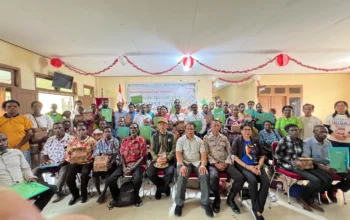
The Indonesian National Police’s International Relations Division (Divhubinter Polri), the Australian Federal Police (AFP), and the Polícia Nacional de Timor-Leste (PNTL) held a trilateral meeting at the Wira Satya Hall of Belu Police Headquarters on Monday, August 3, 2026.
The meeting was aimed at strengthening synergy, coordination, communication and information exchange to improve the effectiveness of efforts to prevent and combat transnational crime along the Indonesia–Timor-Leste border and the wider region connected to Australia.
“The key to solving these challenges lies not only in enforcement, but also in accelerating information exchange and strengthening cooperation at the operational level.”
— Commissioner Juara Silalahi, Indonesian National Police International Relations Division
The meeting, which began at 4:15 p.m. local time, was attended by senior Indonesian police officials, including Commissioner Juara Silalahi, S.I.K., M.H., a Senior Interpreter with the Indonesian Police International Relations Division, and Senior Commissioner Fahrul Sudiana, S.H., S.I.K., M.Si., Acting Head of the Monitoring and Evaluation Subdivision of the Indonesian National Central Bureau (NCB) Interpol.
Belu Police Chief Senior Commissioner I Gede Eka Putra Astawa, S.H., S.I.K., senior officers and police chiefs from border-area precincts also attended.
The Australian Federal Police delegation included Federal Agent Sarah Hammond from AFP Dili, Timor-Leste; Federal Agent Judy Goldsmith from AFP Bali, Indonesia; and AFP Dili local staff member Dalia Das Regas.
The PNTL delegation was represented by Chief Superintendent Calisto Gonzaga of the Border Police Unit, Chief Superintendent Boavida Ribeiro of the Intelligence Unit, Chief Superintendent Eugenio Pereira of the Maritime Unit, and Inspector Assistant Esterlita Gama Soares of International Relations.
The meeting was moderated by Brigadier Police Officer Andce Beis and opened by Belu Police Chief I Gede Eka Putra Astawa, who expressed his appreciation that Belu had been entrusted to host the trilateral gathering involving the Indonesian National Police, the AFP and the PNTL.
As the police force responsible for maintaining public security in Indonesia’s border region with Timor-Leste, Belu Police expressed full support for the meeting.
The police chief said information sharing, coordination and a shared commitment were essential to maintaining stability and security across the Indonesia–Timor-Leste border and the wider region linked to Australia.
“Border security challenges cannot be addressed by one country alone. Transnational crimes require synergy and cross-border cooperation.”
— Senior Commissioner I Gede Eka Putra Astawa, Belu Police Chief
“As an area directly bordering Timor-Leste, we recognize that security challenges in the border region cannot be faced alone. Transnational crimes such as drug smuggling, human trafficking and illegal border crossings require synergy and cooperation across countries,” Astawa said.
He added that Belu Police was ready to support agreements and action plans resulting from the meeting.
With a spirit of cooperation and professionalism, he expressed confidence that the partnership could help create a safe and stable environment for communities living along the border.
Meanwhile, Commissioner Juara Silalahi of the Indonesian National Police International Relations Division welcomed the continuation of strategic cooperation among the three institutions in addressing transnational crime.
He said border security was a shared responsibility.
Belu Regency, which directly borders Timor-Leste, occupies a strategic geographical position while also facing potential threats linked to transnational criminal activity.
“The Indonesian National Police International Relations Division, as the institution responsible for international police relations, has a duty to build and strengthen cooperation with police forces from partner countries. This trilateral meeting is a concrete expression of our commitment not to work alone in confronting threats that recognize no national boundaries,” Silalahi said.
Through the meeting, Indonesian police officials called for faster, more accurate and secure intelligence sharing, closer operational coordination in handling cross-border cases, and more effective communication mechanisms among the AFP, PNTL and Indonesian National Police, particularly at the provincial and district levels.
“I appreciate the presence of the AFP and PNTL delegations. Your presence demonstrates our shared commitment to maintaining security and stability in the region. Let us make the most of this meeting to develop concrete action plans that can be implemented immediately in the field,” Silalahi said.
From the Australian side, AFP Federal Agent Sarah Hammond said Australia, Indonesia and Timor-Leste were geographically interconnected. The proximity of the three countries means that security threats emerging in one country could have direct consequences for the others.
The AFP is currently focusing on three major threats in the region: people smuggling and human trafficking, narcotics, and illegal chemical substances.
“These threats cannot be addressed by any one country alone. Trilateral cooperation of this kind is both important and strategic.”
— Sarah Hammond, Australian Federal Police Federal Agent
“Criminal networks continue to target land and maritime routes in our region, using Timor-Leste and East Nusa Tenggara as transit routes toward Australia. We recognize that these threats cannot be faced alone,” Hammond said.
She said the AFP remained ready to assist in addressing crimes affecting the borders of Australia, Timor-Leste and Indonesia, while reaffirming its commitment to working closely with Indonesian and Timor-Leste counterparts.
The PNTL representative, Chief Superintendent Calisto Gonzaga, said challenges along the border included human trafficking and people smuggling, the illegal movement of goods and narcotics, as well as border crossings without official documentation.
The PNTL expressed hope that the meeting would strengthen intelligence exchange, expand coordinated patrols and joint operations, and improve personnel capacity.
The three delegations then moved into a discussion session, during which Belu Police and the PNTL addressed continuing cross-border crimes involving both maritime routes and unofficial land crossings, commonly known as “rat routes.”
Among the crimes discussed were livestock theft, motor vehicle theft, and the smuggling of people and goods.
In response, the Indonesian National Police International Relations Division, acting as a communication bridge between the Indonesian National Police, PNTL and AFP, urged all parties to strengthen synergy, coordination, communication and information exchange.
“The agreements reached must become a concrete expression of cooperation among the Indonesian National Police, PNTL and AFP in combating transnational crime in the border region.”
— Commissioner Juara Silalahi, Indonesian National Police International Relations Division
“We agree that the key to resolving these challenges is not only enforcement, but also faster information exchange and stronger cooperation at the operational level. We will also report the outcomes to the regional leadership in East Nusa Tenggara, including the East Nusa Tenggara Police Chief and relevant units, so that cooperation between the police forces of the two countries can be properly implemented,” Silalahi said.
In a broader context, the trilateral meeting underlines a fundamental reality of modern border security: borders may divide territories, but they cannot contain transnational crime on their own. Criminal networks move through geographical and technological gaps, requiring law enforcement agencies to build networks of cooperation that can respond faster than the criminal networks themselves. Secure intelligence sharing, coordinated patrols and direct institutional communication are therefore essential to preventing border areas from becoming safe havens for illicit activities.
For Belu and East Nusa Tenggara, the cooperation carries an even broader significance. The border is not merely a line separating two nations. It is also a living space where communities interact daily through human mobility, trade and cross-border economic activity.
Security, therefore, should not be measured solely by the ability to arrest offenders after crimes occur. It also depends on the ability to identify threats early, share information before it is too late, and build trust among countries that share the same geographical neighborhood.
The trilateral meeting concluded in a warm atmosphere with a group photograph and the presentation of a souvenir from the Polícia Nacional de Timor-Leste to the Belu Police Chief.
From Belu, the message was simple but far-reaching: when crime crosses borders, cooperation must cross them too.
Because at the frontier, security is not merely about protecting the lines that separate nations. It is about ensuring that beyond those lines, communities can continue to live in safety, peace and dignity.